
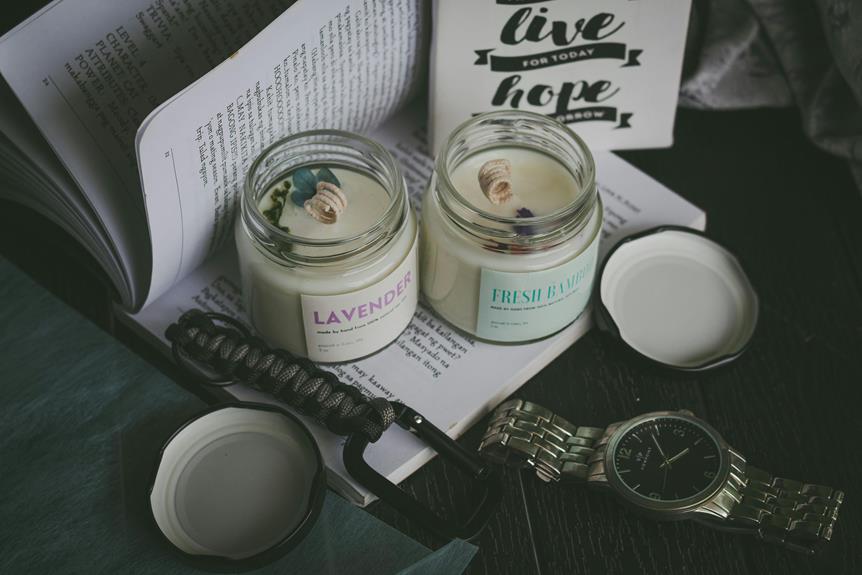
You've likely been misled about soy candles, and it's time to set the record straight. Myth-busting time! Soy candles aren't always healthier; they still contribute to indoor pollution, albeit to a lesser extent. Soy wax isn't completely eco-friendly, as its production can harm the environment. And, sorry, soy candles don't necessarily burn longer or produce less soot. They're not cheaper to make either, and their scent throw depends on multiple factors. Soy wax isn't inherently hypoallergenic, and its melting point is actually relatively low. As you explore the world of soy candles, you'll discover more surprising truths that will change your perspective.
Key Takeaways
- Soy candles are not entirely healthier, as they still contribute to indoor pollution and can aggravate respiratory issues like asthma.
- Soy wax is a more sustainable option than paraffin wax, but its eco-friendliness depends on factors like farming practices and transportation.
- Soy candles don't necessarily burn longer than other candles, as burning time depends on wax formulation, wick size, and melting point.
- Production costs of soy candles are likely to be on par with other types of candles, considering labor expenses and precise temperature control.
- Soy wax is not inherently hypoallergenic and can still cause skin irritations, emphasizing the need for responsible processing and natural ingredients.
Soy Candles Are Always Healthier
Since you're considering switching to soy candles, you've likely heard that they're always a healthier alternative to traditional candles.
While it's true that soy candles have some health benefits, the notion that they're always healthier might be a bit exaggerated. For one, soy candles can still contribute to indoor pollution, albeit to a lesser extent than traditional candles. The combustion process releases particles and volatile organic compounds (VOCs) into the air, which can aggravate respiratory issues like asthma.
However, soy candles do have an advantage when it comes to allergy concerns.
They tend to produce fewer soot particles and VOCs than traditional candles, making them a better choice for those with sensitivities. Additionally, soy wax is a natural, non-toxic material that's less likely to trigger allergic reactions.
Soy Wax Is Completely Eco-Friendly
You might assume that soy wax is completely eco-friendly, given its natural origins and biodegradable properties, but the reality is more complex.
While it's true that soy wax is a more sustainable option than paraffin wax, its eco-friendliness depends on several factors.
Soy sourcing, for instance, can have a significant environmental impact. Large-scale soy farming can contribute to deforestation, habitat destruction, and water pollution. Additionally, many soy farms rely on genetically modified organisms (GMOs) and pesticides, which can harm biodiversity and ecosystems.
Farming practices also play a vital role in determining the eco-friendliness of soy wax.
Sustainable farming practices, such as organic farming and crop rotation, can minimize the environmental impact of soy production. However, these practices aren't always adopted by soy farmers.
Moreover, the processing and transportation of soy wax can also generate greenhouse gas emissions.
So, while soy wax has some eco-friendly qualities, a thorough examination of the entire production process is necessary to get an accurate picture of its environmental impact.
Soy Candles Burn Longer Than Others
Burning longer than other types of candles is a common claim made about soy candles, but how much truth lies behind this assertion?
When you look at the facts, you'll find that soy candles don't necessarily burn longer than their counterparts. The burning time of a candle depends on various factors, including the wax formulation, wick size, and melting point. Soy wax, in particular, has a lower melting point than other types of wax, which means it can melt and burn faster.
However, some soy candle manufacturers have developed specialized wax formulations that can increase the burning time of their products. These formulations often involve blending soy wax with other types of wax, such as beeswax or paraffin wax, to create a more durable and longer-lasting candle.
Soy Candles Are Cheaper to Make
Another myth surrounding soy candles is that they're cheaper to produce than other types of candles, but is this claim rooted in reality?
As you enter the world of candle-making, you'll quickly realize that production costs don't necessarily favor soy candles. While soy wax itself might be relatively inexpensive, the labor expenses involved in crafting a high-quality soy candle can be substantial.
You'll need to weigh the time and effort required to carefully melt the wax, add colorants and fragrances, and pour the mixture into molds. Additionally, soy wax often requires more precise temperature control and a longer cooling time, which can increase production time and, subsequently, labor costs.
When you factor in the cost of equipment, marketing, and other business expenses, the difference in production costs between soy candles and other types of candles becomes negligible. So, while soy wax might be cheaper, the overall cost of producing a soy candle is likely to be on par with other types of candles.
Soy Wax Has a Higher Melting Point
Misconceptions about soy wax's thermal properties have led many to believe that it has a higher melting point than other waxes, but does the science support this claim?
As you explore the world of soy candles, it's essential to understand the wax's structure and how it affects its performance. Soy wax, being a natural, plant-based wax, has a relatively lower melting point compared to other waxes like paraffin or beeswax.
Soy wax typically melts between 120°F to 140°F (49°C to 60°C), which is lower than other waxes.
Soy wax requires precise temperature control during the melting process to prevent overheating, which can affect its structure and performance.
Soy wax has a more open crystal structure, making it more prone to softening and deforming under heat.
Soy wax is often blended with other waxes to improve its thermal properties and stability.
Soy Candles Produce Less Soot
As you explore the benefits of soy candles, you might assume that they produce less soot than their paraffin counterparts, but is this assumption based on fact or fiction?
The truth is, soy candles do produce less soot than paraffin candles. Soot particles are a byproduct of incomplete combustion, and soy wax tends to burn more efficiently, resulting in fewer soot particles released into the air.
This is especially important for indoor use, as soot particles can aggravate respiratory issues and contribute to poor air quality.
When you burn a soy candle, you can breathe easier knowing that you're promoting clean air in your home.
In contrast, paraffin candles release more soot particles, which can settle on surfaces and even be inhaled, compromising the air you breathe.
While no candle is completely soot-free, soy candles are a better choice if you're concerned about indoor air quality.
Soy Candles Have a Stronger Scent
While shopping for candles, you're likely drawn to those with strong, inviting scents, but do soy candles really hold their own when it comes to fragrance throw? The answer is, it depends. Soy candles can have a strong scent throw, but it's not always the case.
Quality of fragrance oils, wax melting point, fragrance loading, and burn time and temperature are factors that affect the scent throw of soy candles.
- Quality of fragrance oils: High-quality oils with a high concentration of essential oils will generally produce a stronger scent.
- Wax melting point: Soy wax with a higher melting point can hold more fragrance oil, resulting in a stronger scent throw.
- Fragrance loading: The amount of fragrance oil added to the melted wax affects the strength of the scent.
- Burn time and temperature: The longer and hotter the candle burns, the more fragrance is released.
While soy candles may not always have the strongest scent throw, they do offer a wide range of fragrance options. From fruity and floral to spicy and woody, you're sure to find a scent that suits your taste.
Soy Wax Is Hypoallergenic and Gentle
You've likely heard that soy wax is a gentle, hypoallergenic choice for those with sensitive skin, but is this claim entirely accurate?
While soy wax is generally considered a natural and gentle ingredient, it's vital to separate fact from fiction. Soy wax can still cause skin irritations in some individuals, especially those with severe allergies or sensitivities.
The reason behind this myth is that soy wax is often blended with other natural ingredients, which can affect its hypoallergenic properties.
For instance, some soy wax candles may contain essential oils or fragrances that can trigger skin reactions. Additionally, soy wax can be processed using chemicals or additives that can negate its natural benefits.
Important to note that soy wax isn't inherently hypoallergenic.
However, when sourced from high-quality, natural ingredients and processed responsibly, soy wax can be a gentle choice for most people.
If you have sensitive skin, it's necessary to exercise caution and patch test any new soy wax products before using them extensively.
Soy Candles Are Completely Sustainable
Soy wax's hypoallergenic properties are clearer, but another claim associated with soy candles is that they're completely sustainable. However, the reality is more complex.
While soy is a renewable resource, the journey from farm to candle isn't entirely green.
Soybean farming can involve intensive water and pesticide use, which can harm local ecosystems.
Large areas of land are dedicated to soybean production, leading to deforestation and habitat destruction.
Soybeans are often transported long distances, contributing to greenhouse gas emissions and a larger carbon footprint.
The process of converting soybeans into wax and then into candles requires energy and resources, adding to the environmental impact.
These factors bear examination when evaluating the sustainability of soy candles. While soy candles have some sustainable advantages, they're not entirely eco-friendly.
Frequently Asked Questions
Can I Make Soy Candles at Home Without Any Special Equipment?
You can make soy candles at home without special equipment, but prioritize candle safety by following melting tips, like using a double boiler and thermometer, to promote a smooth, even burn.
How Do I Store Soy Candles to Maintain Their Quality?
As you're busy crafting soy candles at home, you're probably wondering how to store them to maintain their quality. You'll want to use candle shelves to keep them upright and away from direct sunlight, while also practicing temperature control to prevent melting or cracking.
Can I Color Soy Wax With Natural Ingredients Like Herbs?
You can color soy wax with natural ingredients like herbs through botanical infusions or natural dyes, but be cautious as the results may vary, and some herbs might not produce the desired hue or consistency.
Do Soy Candles Attract Dust or Dirt Easily?
You're thinking soy candles are dust magnets, aren't you? Irony is, they're actually less prone to attracting dust particles due to their natural, non-petroleum base, which reduces static charge and dust accumulation, leaving your candle clean and dust-free.
Can I Reuse Soy Wax From Melted Soy Candles?
You're wondering if you can reuse soy wax from melted soy candles. The answer is yes! You can recycle the wax by melting the remnants and re-purifying them for a new candle, reducing waste through wax recycling.
Conclusion
You've made it to the end of our myth-busting journey, and what've you learned?
That soy candles aren't always the saints they're made out to be. In fact, some of their supposed benefits are just plain myths.
So, the next time someone tells you that soy candles are the epitome of eco-friendliness and healthiness, you can politely (or not so politely) set them straight.
And who knows, you might just find yourself enjoying a guilty pleasure – a paraffin wax candle that's actually better for the environment than its soy counterpart.